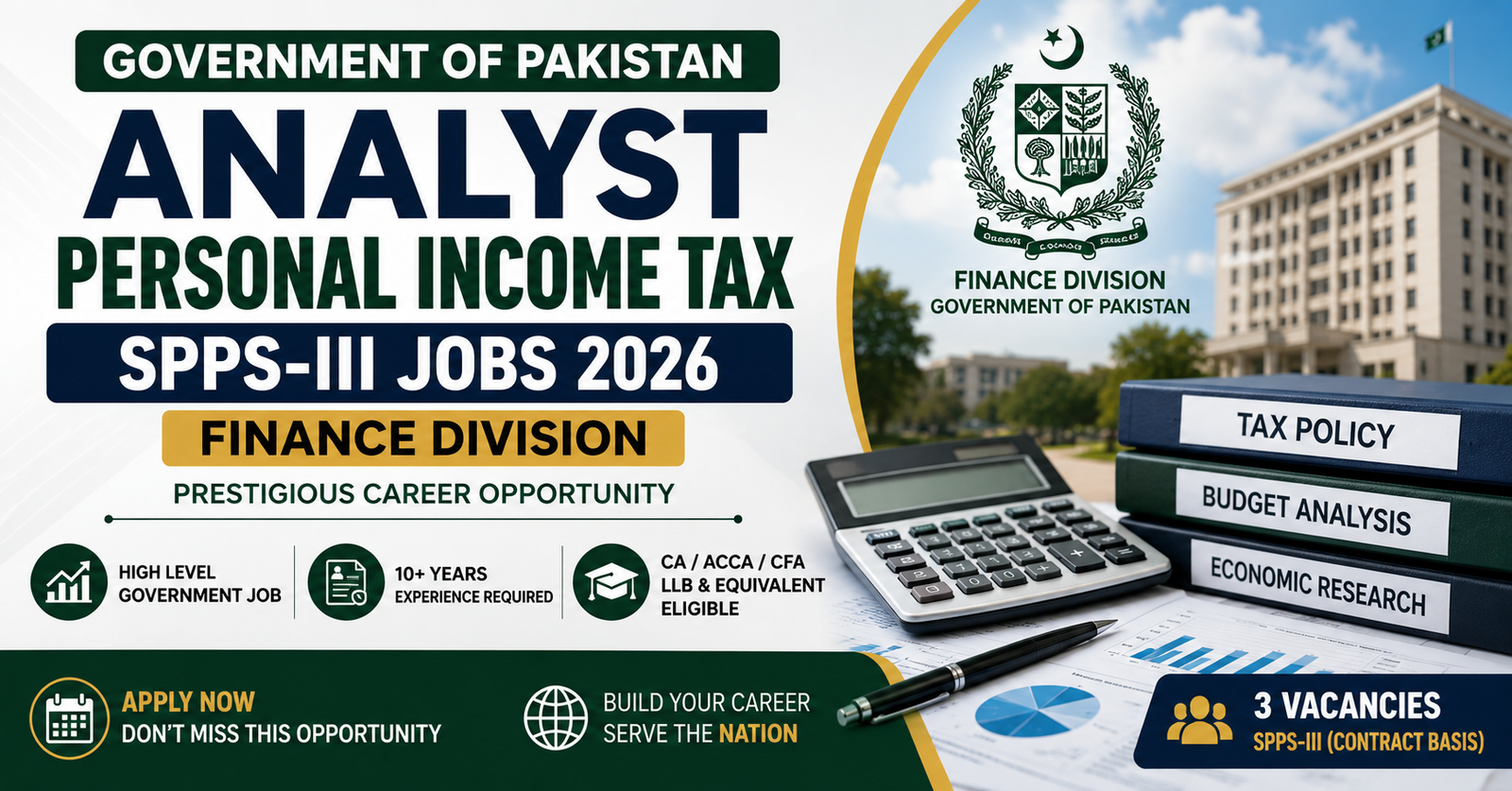
Overview of Analyst Personal Income Tax Jobs 2026
The position of an Analyst Personal Income Tax SPPS-III which is announced by the Finance Division, Government of Pakistan is a highly specialized and senior-level professional opportunity which is designed for an experts in the taxation, finance, and analysis of an economic policy. This role is not a typical clerical or general administrative job; instead, it have focuses on an advanced analytical work which is related to a policy of tax, income tax structure, evaluation of budget, and fiscal reforms in the Pakistan.
This position is offered on a contract basis under the SPPS-III pay scale, which have represents a senior professional pay structure within the public sector. Candidates who will be selected for this role will be responsible for analyzing a complex systems of taxation, identifying a gaps in the existing tax laws, and suggesting an improvements in policy that can help to improve a collection of national revenue and economic stability.
The role have demands a strong analytical thinking, deep understanding of the taxation system of Pakistan, and the ability to work with a legal and financial data. Professionals from the CA, ACCA, CFA, CMA, LLB, or equivalent backgrounds are considered as suitable due to the technical nature of the job. In an addition, candidates must have at least a 10 years of the post-qualification experience in a taxation or related financial fields.
This job is highly relevant for an individuals who want to contribute as directly to a national financial policy making. It also offers a prestigious career path within the government sector, especially for professionals who have experience in tax consultancy, audit firms, financial institutions, or public sector financial departments.
Finance Division Government of Pakistan – Job Introduction
The Finance Division of the Government of Pakistan is one of the most important institutions that are responsible for managing the financial system of country, which is including a policies of taxation, budgeting, economic planning, and strategies for a generation of revenue. Every major financial decision of the government is influenced by the analytical work performed within this division.
The Analyst Personal Income Tax SPPS-III position plays a critical role in supporting evidence-based policy making. The selected candidate will work as closely with a senior directors and policymakers to provide a data-driven insights on the tax reforms, strategies of a revenue generation, and economic implications of the tax policies.
This role is especially important in the context of evolving economic challenges of Pakistan, where improving a compliance of tax and increasing the collection of a revenue are the key national priorities. Analysts are expected to evaluate an exemptions of tax, review the financial data, and propose an amendments that have align with an objectives of economic growth.
The Finance Division have ensures that a tax policies are not only legally sound but also economically viable. Therefore, analysts are required to conduct a cost-benefit analysis, review the judicial decisions as related to a taxation, and assess the impact of a tax reforms on long-term on different sectors of the economy.
Overall, this job is ideal for a professionals who want to work at the intersection of a finance, law, and public policy, with contributing to a national-level economic processes of decision-making.
Job Responsibilities and Key Duties
The responsibilities of an Analyst Personal Income Tax SPPS-III are highly analytical and policy-oriented. The job have involves a detailed examination of tax systems, financial records, and a legal frameworks to support the decision-making at the level of government.
One of the core responsibilities is the quantitative and qualitative analysis of an existing tax laws, particularly those that are related to a personal income tax, capital gains, and income from property. The analyst must identify an inefficiencies, loopholes, and areas where a reforms of tax are required. This have requires a strong technical knowledge of the tax legislation as well as a practical understanding of the financial systems.
Another important duty is the review of a budgetary proposals that are received from a different stakeholders, which is including a departments of government and economic advisors. The analyst have evaluates that whether these proposals are economically viable and aligned with a national fiscal goals. This have involves a detailed financial modeling and assessment of policy.
Additionally, the analyst is responsible for an analysis of tax gap and tax expenditure analysis. Tax gap analysis have helps to determine the difference in between an expected revenue of tax and actual collection, while analysis of a tax expenditure have evaluates the cost of a tax exemptions and incentives that are provided by the government.
Cost-benefit analysis of a proposed tax changes is also a critical part of the job. This have ensures that any new tax policy delivers a maximum economic benefit while minimizing the negative impact on a businesses and individuals.
Finally, the analyst must also review a judicial pronouncements as related to the taxation to ensure that the recommendations of policy are legally consistent and up to date with a decisions of court.
Eligibility Criteria and Required Qualifications
The criteria of eligibility for the position of an Analyst Personal Income Tax SPPS-III are highly strict because this role have requires an advanced-level expertise in a taxation, finance, and legal analysis. Candidates must possess a strong academic qualifications along with the professional certifications that have demonstrate a deep understanding of the financial systems and tax laws.
Applicants are generally required to hold a degrees such as the CA (Chartered Accountancy), ACCA, CFA, CMA, LLB, or equivalent international qualifications. These qualifications have ensure that the candidate has both a theoretical and practical knowledge of the accounting, auditing, taxation, and financial reporting systems. In an addition, candidates with a BS (4-year program) or M.Com degrees in the Accounting, Finance, Taxation, or Auditing from a recognized universities are also eligible to apply.
Another important requirement is a strong understanding of the Pakistani tax laws, especially non-corporate taxation areas such as the salary income, capital gains, and income from property. Since the role is a policy-focused, candidates must be familiar with how a tax systems have operate at both an individual and national levels.
This position have also requires an analytical thinking and the ability to interpret a complex financial data. Therefore, candidates with an experience in the consultancy firms of tax, audit firms, financial institutions, or government departments are preferred. Strong skills of a research, attention to detail, and ability to work under a pressure are the essential qualities for a success in this role.
Professional Certifications and Academic Background
Applicants with a professional certifications such as the CA, ACCA, CFA, CMA, CPA (Canada, UK, USA, Australia), CIA, or ICMA are highly preferred. These certifications have demonstrate a strong technical expertise in the accounting, finance, and fields of auditing.
Law graduates (LLB or BA LLB) are also eligible, especially those with an experience in the interpretation of a tax law and legal drafting. The combination of a law and finance knowledge is considered as highly valuable for this position because a development of tax policy have requires both a legal and economic understanding.
Required Skills and Professional Competencies
The role of an Analyst Personal Income Tax SPPS-III have requires a combination of the technical, analytical, and skills of a communication. One of the most important skills is a data analysis and financial interpretation. Candidates must be able to work with a large datasets that are related to a collection of tax, revenue patterns, and economic indicators.
Advanced Excel skills are essential, which is including a functions like as pivot tables, data modeling, and financial calculations. In an addition, familiarity with a tools of data visualization such as the Power BI or similar platforms is highly beneficial for presenting an analytical findings in a clear and understandable format.
Strong research and skills of drafting are also required. Analysts must prepare a concise technical notes, policy briefs, and recommendations for the senior officials of government. These documents must be accurate, well-structured, and based on a solid evidence.
Communication skills are equally important because the role have involves presenting a findings to the directors, policymakers, and other stakeholders. The ability to simplify a complex tax data into clear insights is a key requirement.
Critical thinking and problem-solving abilities are also essential. Analysts must evaluate a different options of policy, identify the potential risks, and suggest a practical solutions that have improve an efficiency of tax and economic outcomes.
Experience Requirements for SPPS-III Analyst Role
A minimum of 10 years of post-qualification experience is required for this position. This experience must be in a taxation, auditing, financial analysis, or related fields. Candidates who have worked in a reputable CA firms, multinational companies, government institutions, or financial consultancy organizations are preferred.
Experience in an areas such as the salary income taxation, property income, capital gains, and corporate tax advisory is highly valuable. Candidates must demonstrate a practical exposure to the tax systems and policy frameworks on a real-world.
In an addition, experience in the preparation of budget, financial reporting, and compliance of tax is considered as an advantage. The government have seeks for a professionals who can bring a practical industry knowledge into the processes of a policy-making.
Application Process and How to Apply
The application process for the Analyst Personal Income Tax SPPS-III position is typically conducted through official government channels. Candidates are required to submit their applications along with a detailed CVs, educational documents, and certificates of experience.
Applicants must carefully review the official advertisement and ensure that all the criteria of eligibility are met as before applying. Incomplete applications or those who are lacking a required documents are usually rejected in during the stage of initial screening.
Shortlisted candidates are called for an interviews or technical assessments, where their knowledge of a taxation laws, financial analysis, and development of policy is evaluated. The process of selection is highly competitive due to the senior nature of the position.
It is important for a candidates to prepare as thoroughly for the interview by understanding Pakistan’s tax system, changes in a recent budget, and current economic challenges.

Salary, Grade, and Benefits Details
The SPPS-III pay scale have represents a senior-level professional government position with a competitive packages of salary. Although an exact figures may vary, positions under a SPPS-III have generally offer an attractive compensation which is aligned with a high-level expertise and responsibilities.
In an addition to the salary, selected candidates may also receive a benefits from government such as job stability (contract-based), environment of a professional working, and opportunities to contribute to a national policy-making.
This position have also provides a significant prestige in career, as working with the Finance Division at this level is considered as highly respected in the public finance and sector of taxation.
Importance of Tax Policy Analyst in Government Sector
Tax policy analysts have play a crucial role in shaping the economic direction of a country. In Pakistan, where a generation of revenue and tax compliance are the key challenges, professionals in this role have help to design an efficient systems of tax that have support an economic growth.
By analyzing a tax laws, identifying the loopholes, and suggesting a reforms, analysts have contribute as directly to improving a collection of government revenue. Their work have also ensures a fairness in the taxation and helps to reduce an inequality in the system of tax.
Career Growth Opportunities in Finance Division Pakistan
Working as an Analyst Personal Income Tax SPPS-III opens doors to advanced career opportunities in public finance, economic policy, and taxation advisory roles. Professionals can progress into a positions of senior advisory, roles of a policy leadership, or opportunities of an international consultancy.
Experience which is gained in this role is highly valuable for a future roles in the international financial institutions, tax advisory firms, and government economic departments.
FAQs
What is the Analyst Personal Income Tax SPPS-III job?
It is a senior-level government position in a Finance Division Pakistan which is focused on an analysis of a tax policy and evaluation of a income tax.
What qualifications are required for the SPPS-III Analyst job?
Candidates need a CA, ACCA, CFA, CMA, LLB, or equivalent finance and taxation-related degrees.
How much experience is required for this job?
A minimum of the 10 years post-qualification experience in a taxation, finance, or related fields is required.
What is the main role of a Tax Analyst in the Finance Division?
The role have involves analyzing a tax laws, reviewing the budgets, and suggesting an improvements in policy for a better management of revenue.
Final Thoughts on Analyst Personal Income Tax Jobs 2026
The position of a Analyst Personal Income Tax SPPS-III in the Finance Division Government of Pakistan is a prestigious and highly specialized opportunity for an experienced professionals in the taxation and finance. It have offers a unique chance to directly contribute to national economic policy-making and initiatives of tax reform.
With a strong criteria of eligibility, requirements of an advanced skill, and significant responsibilities, this role is ideal for an individuals who want to work at a strategic level in the government financial systems. Candidates with the right qualifications and experience can expect a highly rewarding career path in the public sector finance and development of a taxation policy.