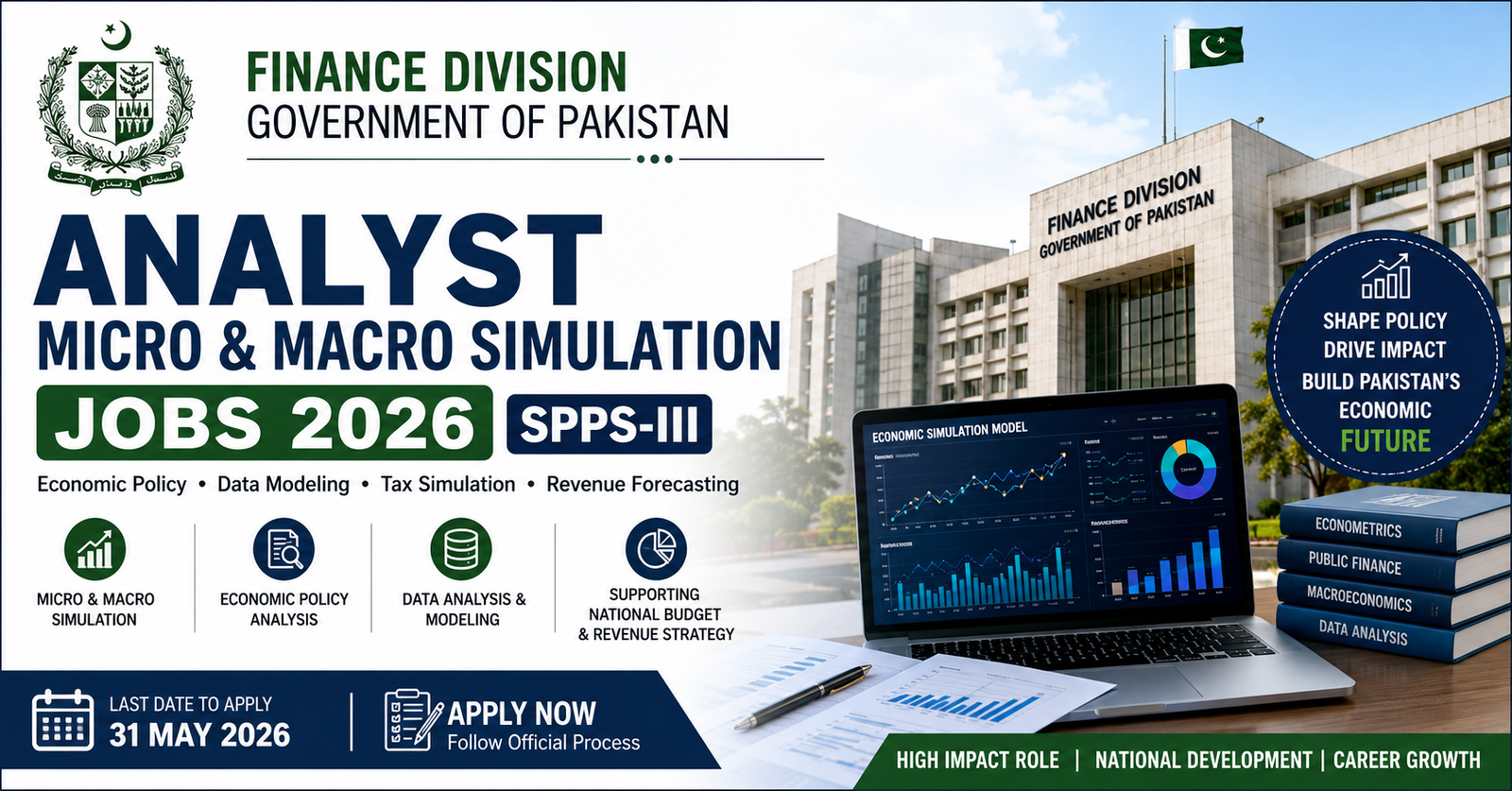
Introduction – Analyst Micro and Macro Simulation Jobs 2026
The Analyst Micro and Macro Simulation Jobs 2026 announced by the Finance Division, Government of Pakistan represent one of the most advanced and technical roles in the public sector. This SPPS-III level position is designed for a highly skilled professionals in the economics, statistics, econometrics, and data analytics who can support a national-level formulation of a fiscal policy. Unlike a traditional jobs in government, this position have focuses on an economic modeling, systems of a tax simulation, and macroeconomic forecasting that have directly influence the annual budget of Pakistan, strategies of a revenue generation, and economic planning on long-term.
In today’s data-driven governance system, governments have rely as heavily on a models of simulation to predict the impact of a tax policies, adjustments of revenue, and economic reforms. This role is specifically designed to build and maintain those models with using an advanced tools such as the Python, R, Stata, SPSS, Excel, and Power BI. The selected analysts will work as closely with a senior makers of policy to analyze the income tax, GST, customs duties, and policies of excise, with ensuring that a financial decisions are based on an accurate and data-backed insights.
This position is not only a job but a strategic career opportunity for an individuals who want to contribute to a national economic development. With a contract-based structure of SPPS-III, it have offers a competitive salary package, exposure to the high-level decision-making in government, and career growth on long-term in a research of policy, data science, and economic analysis fields. For a professionals who are seeking a government analyst jobs in Pakistan 2026, this role have stands out as one of the most prestigious and technical opportunities that are available.
Job Overview – Finance Division Government of Pakistan Analyst Role
The position of a Finance Division Analyst Micro and Macro Simulation is a specialized government job that have focuses on an economic research, fiscal modeling, and simulation of policy. The job have requires a candidates who can analyze the complex datasets and convert them into a meaningful insights for the policy decisions. The primary objective of this role is to support a revenue forecasting and planning of budget through the models of a micro and macroeconomic simulation.
At the micro level, analysts will evaluate the structures of an individual tax, household income data, and sector-specific financial behavior. At the macro level, they will analyze a national economic indicators such as the GDP growth, rates of inflation, trade balances, and a fiscal deficits. These analyses have help the government to understand that how a different policy decisions have impact the overall economy.
The SPPS-III scale have indicates a senior-level technical position, which is usually reserved for a highly qualified professionals with a strong academic backgrounds and at least five years of the relevant experience. The selected candidates will work with an institutions of a data from such as the Federal Board of Revenue (FBR), Pakistan Bureau of Statistics (PBS), and State Bank of Pakistan (SBP). This have makes the job as highly analytical, research-intensive, and data-driven.
This role is particularly important because it have directly supports the preparation process of Annual Budget and Medium-Term Revenue Strategy (MTRS). Analysts will also contribute to a fiscal notes, working the papers, and policy reports that have guide a national economic decisions. For a candidates who are looking for an economic policy analyst jobs in Pakistan, this position have offers a rare combination of the research, modeling, and government-level impact.
Key Responsibilities – Micro and Macro Economic Simulation Work
The responsibilities of an Analyst Micro and Macro Simulation in the Finance Division are highly technical and require a strong analytical thinking. One of the primary duties is to design and maintain a micro-simulation and macro-simulation models that have evaluate the impact of a tax policies. These models have help the policymakers to understand that how a changes in the taxation affect a different groups of income, industries, and the national economy.
Another major responsibility is conducting a quantitative analysis of the fiscal measures. This have includes evaluating how a proposed tax reforms will impact the government revenue, economic growth, and distribution of income. Analysts are also responsible for simulating a different scenarios of policy to help the decision-makers choose the most effective economic strategies.
Data collection and processing is another critical component of this role. Analysts must compile a datasets from the multiple sources, which is including a household surveys like as HIES and PSLM, as well as administrative records from the databases of FBR and LSM. These datasets must be cleaned, validated, and prepared for a use in the models of simulation.
Additionally, analysts are expected to prepare a detailed reports, policy briefs, and analytical documents for the senior officials. These reports must clearly present the findings in a structured and actionable format. Data visualization using the tools like as Power BI is also an important part of the job, as it have helps to transform a complex datasets into easy-to-understand dashboards for the decision-makers.
Eligibility Criteria – Education and Qualification Requirements
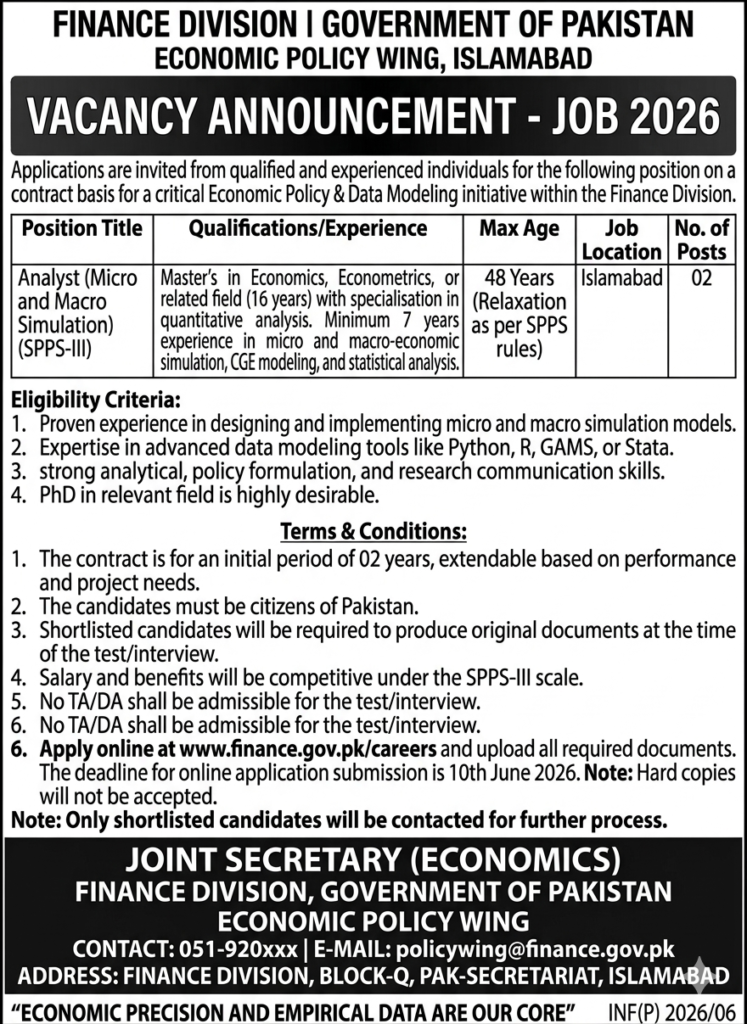
To apply for the Analyst Micro and Macro Simulation Jobs 2026, candidates must have at least a 18 years of education in a relevant fields such as the Economics, Econometrics, Statistics, Data Analytics, or related disciplines. Degrees like as MPhil Economics, MSc Statistics, MS Data Analytics, or equivalent qualifications from an HEC-recognized or foreign universities are preferred.
The Finance Division have places a strong emphasis on an analytical and technical expertise. Candidates with an advanced knowledge of the econometrics, statistical modeling, and tools of a data science have a higher chance of the selection. Familiarity with a languages of programming such as Python and R, along with a statistical tools like as Stata and SPSS, is considered a major advantage.
In an addition to the academic qualifications, candidates must demonstrate a strong abilities of analytical thinking. They should be capable of interpreting a complex economic data, with identifying the patterns, and presenting a clear insights for the policy decisions. Understanding a Pakistan’s tax structure and familiarity with the institutions such as FBR, PBS, and SBP is also highly desirable.
Preference is given to a candidates who have an experience in the environments of research, think tanks, or government policy institutions. This have ensures that a selected individuals can quickly adapt to the technical and analytical demands of the job.
Required Skills – Data Analysis and Economic Modeling Expertise
This role have demands a strong combination of the technical, analytical, and research skills. Candidates must be proficient in an analysis of data tools such as Excel, SPSS, Stata, R, Python, and Power BI. These tools are essential for building an economic models, performing the simulations, and creating a visual dashboards for the analysis of policy.
Programming skills are particularly important because a models of simulation have often require a coding in the Python or R. These languages are used to process a large datasets, run the statistical models, and generate a predictive economic forecasts. Knowledge of an econometric techniques is also essential for evaluating a relationships in between the economic variables.
Data visualization is another critical skill for this role. Analysts must be able to present a complex data in a clear and understandable format with using a charts, graphs, and dashboards. Tools like as the Power BI and Excel are widely used for this purpose.
In an addition to the technical skills, strong critical thinking and problem-solving abilities are required. Analysts must be able to interpret a data as accurately, identify the implications of policy, and communicate the findings as effectively to a non-technical stakeholders. Strong skills of writing are also necessary for preparing a reports, policy briefs, and papers of research.
Experience Requirements – Professional Background Needed
The role of a Analyst Micro and Macro Simulation have requires a minimum of the 5 years of a relevant professional experience in the economic analysis, fiscal policy research, data science, or statistical modeling. This experience is essential because the role have deals with a highly sensitive national-level economic data and simulations of policy that have directly influence a government decision-making.
Candidates with an experience in the institutions of research, government departments, think tanks, or international development organizations will have a strong advantage. Practical exposure to an economic forecasting, estimation of a revenue, and data-driven policy evaluation is highly valued. The Finance Division have prefers the individuals who have worked on a real-world datasets and have contributed to the policy reports or financial models in a previous roles.
Experience in handling the large datasets from a sources such as the household surveys, tax records, and macroeconomic indicators is also important. Candidates should be able to demonstrate their ability to clean, process, and interpret a complex datasets as effectively. In an addition, prior work which is involving a tools such as the Python, R, Stata, or Power BI will significantly strengthen the application.
Tools & Technologies Used in This Role
The position of an Analyst is highly technical and requires a mastery of the modern data analytics tools. Candidates are expected to use the Python and R for a statistical modeling, simulation building, and predictive analysis. These languages of a programming are essential for running a micro and macroeconomic simulations that have support the decisions of policy.
Stata and SPSS are also widely used for an econometric analysis and statistical testing. These tools have help in understanding a relationships in between the economic variables such as an inflation, taxation, and distribution of income. Excel have remains a core tool for the financial modeling, data cleaning, and basic analysis tasks.
Power BI and similar tools of visualization are used to create a dashboards that have present an economic insights in a clear and interactive format. These dashboards are often shared with a senior policymakers, which is making the visualization of data a critical part of the job.
In an addition, tools of database management and systems of a data processing are used to handle a large administrative datasets from the institutions like as FBR, PBS, and SBP. Strong command over these tools have ensures an accuracy, efficiency, and reliability in a economic forecasting.
Salary & Benefits – SPPS-III Government Pay Scale
The position of a SPPS-III in the Finance Division have offers a package of competitive salary which is aligned with a senior-level technical roles in the public sector. While an exact figures may vary as depending on a revisions of government and contract terms, SPPS-III positions have typically offer an attractive remuneration as compared to a scales of standard government.
In an addition to the salary, selected candidates may receive a benefits such as the contract-based allowances, performance-based incentives, and an exposure to a high-level projects of policy. One of the biggest advantages of this role is the professional experience which is gained in a national economic planning and development of a fiscal policy.
Working in the Finance Division have also provides a career benefits on long-term, which is including an opportunities for the advancement into a higher roles of policy, international development organizations, and institutions of research. This have makes it as one of the most prestigious roles of an analyst in the public sector of Pakistan.
How to Apply – Application Process for Analyst Jobs 2026
The process of application for Analyst Micro and Macro Simulation Jobs 2026 is typically conducted through an official job portals or Finance Division announcements of government. Candidates must carefully read the official advertisement and submit their applications as before the deadline.
Applicants are required to provide an educational documents, certificates of experience, CNIC, and an updated CV which is highlighting their analytical and technical skills. In some cases, a detailed statement of a purpose or experience in research may also be required.
Shortlisted candidates are usually called for a written test or technical assessment. This may include a questions that are related to an economics, econometrics, analysis of data, and simulation modeling. Candidates who pass the test are then invited for an interview with a panel of the senior officials.
Final selection is based on an academic background, technical skills, relevant experience, and performance in the process of an interview.
Selection Process – Evaluation Criteria
The process of selection for this role of a SPPS-III analyst is highly competitive. Candidates are evaluated on both a technical knowledge and practical experience. The first stage have involves screening of an academic qualifications and professional experience.
The second stage have usually includes a technical assessment, which tests the ability of candidates to work with a data, interpret the economic models, and solve an analytical problems. This may involve a case studies or exercises of a practical simulation.
The final stage is an interview, where the candidates are assessed on their understanding of an economic policy, analytical thinking, and skills of a communication. The panel may also evaluate a familiarity with the tax system of Pakistan and macroeconomic environment.
Only a candidates who demonstrate the capability of a strong analytical and understanding of a policy are selected for this prestigious role.
Career Growth – Future Opportunities in Economic Policy
A career as an Analyst Micro and Macro Simulation have opens a doors to an advanced opportunities in the economic research, development of policy, and data science. Professionals in this field can progress into a senior roles of advisory within the ministries of government, international organizations, and institutions of a research.
With an experience, analysts can move into a positions such as the Senior Economist, Policy Advisor, Data Science Lead, or Fiscal Strategy Consultant. The skills that are gained in this role are also highly transferable to a global organizations such as the World Bank, IMF, and UNDP.
This job is not only a stable position in government but also a gateway to the high-level international economic careers. The combination of an economics and data analytics have makes it as one of the most future-proof paths of a career in the modern job market.
Important Instructions for Applicants
Applicants must ensure that all the information which is provided in their application is accurate and verifiable. Any false information may lead to a disqualification. Candidates should also carefully follow the official guidelines as mentioned in the advertisement of job.
It is important to prepare as thoroughly for the technical assessment, as this role have requires a strong analytical and quantitative skills. Applicants should focus on an econometrics, modeling of data, and policy analysis in during a preparation.
Timely submission of an applications is crucial, as a late submissions are usually not accepted. Candidates are advised to regularly check the official websites of government for an updates and announcements.
FAQs
What is the Analyst Micro and Macro Simulation job in a Finance Division?
It is a government position which is focused on an economic modeling, tax simulation, and analysis of a fiscal policy to support the national budget planning.
What qualifications are required for a SPPS-III Analyst jobs?
Candidates need at least an 18 years of the education in a Economics, Statistics, Econometrics, Data Analytics, or related fields.
What skills are needed for this role?
Skills in the Python, R, Stata, SPSS, Excel, Power BI, and econometric analysis are highly preferred.
How much experience is required?
A minimum of the 5 years of relevant experience in a economic research, analysis of data, or evaluation of policy is required.
Conclusion – Final Overview
The Analyst Micro and Macro Simulation Jobs 2026 in the Finance Division of Pakistan have represent a rare and highly technical opportunity for the professionals in an economics and data science. This position of a SPPS-III have combines analysis of a policy, economic modeling, and advanced analytics of data to support a national-level financial decision-making.
With a responsibilities that are spanning a tax simulation, macroeconomic forecasting, and fiscal policy evaluation, this role is ideal for a highly skilled individuals who want to contribute to an economic development of Pakistan. It have offers not only a competitive salary but also career growth on long-term in both the national and international institutions.
For a candidates who are seeking a government analyst jobs in Pakistan 2026, this position have stands out as one of the most prestigious and impactful roles that are available in the public sector.